


Solved: Is It Sciatica or Just Back Pain? How to Tell the Difference
This article was reviewed by Dr. Zachary J. Bruley, DC (License #5409-12), a board certified chiropractor licensed and practicing in Wisconsin. It is for educational purposes and is not a substitute for professional medical advice, diagnosis, or treatment.
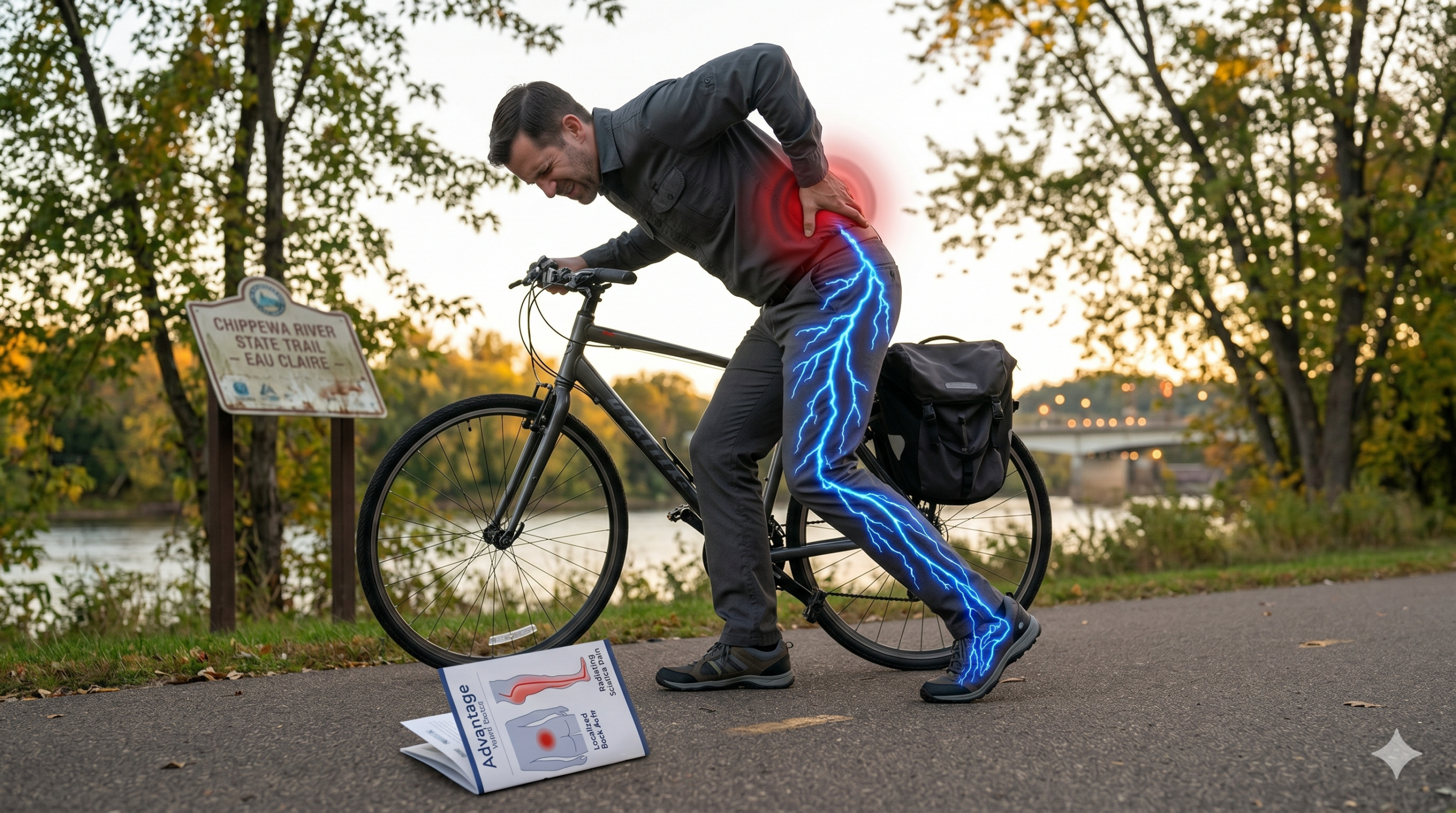
When your back is bothering you, it is not always obvious what kind of problem you are dealing with. A lot of people who come into our Eau Claire clinic describe the same confusion. They are not sure whether they have ordinary low back pain or whether it is sciatica, and the difference actually matters, because the two can call for different care. Here is how to tell them apart, what you can do right now, and when it is time to have someone take a look.
What sciatica actually is
Sciatica is not a condition on its own. It is a description of what happens when something irritates or presses on the sciatic nerve, which is the large nerve that runs from your lower back through each hip and down the back of the leg. When that nerve gets compressed, often by a disc issue in the lower spine or by tight muscles pressing on it, the pain does not stay put in your back. It travels.
That traveling quality is the biggest clue.
How to tell the two apart
Ordinary low back pain usually stays in the back. It tends to feel like a deep ache, a soreness, or a stiffness centered in the lower spine, and it often gets worse with certain movements and better with rest or gentle activity.
Sciatica tends to announce itself differently. The pain commonly runs from the lower back or buttock down through one leg, sometimes all the way to the foot. People describe it as burning, shooting, or electric rather than a dull ache, and it often comes with numbness, tingling, or a pins and needles feeling along the way. It is usually felt on one side. Many people notice it flares when they sit for a long time, which is part of why commuters and desk workers around Eau Claire tend to feel it on their longer days.
If your discomfort is mostly local and achy, it is more likely simple back pain. If it shoots down a leg and brings tingling or numbness with it, that points toward sciatica.
What helps, starting today
Whichever one you are dealing with, a few gentle steps tend to help in the early going.
Keep moving in easy ways rather than lying flat for days, because gentle motion usually does more good than total rest. Break up long stretches of sitting, especially on long drives, by standing and walking for a few minutes. Many people get some relief from a gentle stretch that opens up the hip and buttock on the affected side, as long as they ease into it slowly. Warmth can help relax the area too.
Go gently with all of this. If any movement sends a sharper jolt down your leg, back off. These are general comfort measures to get you through, not a treatment plan, and every body responds a little differently.
When it is more than you should handle alone
Some signs mean you should be seen sooner rather than later. Pay attention if you notice weakness in a leg or foot, if your foot starts catching or dragging when you walk, or if the pain is severe and steadily getting worse rather than easing. If you ever feel numbness around the groin or lose control of your bladder or bowels, treat that as an emergency and get care right away.
When the simple steps are not making a dent after a week or two, that is usually the moment to stop guessing and have a professional find out what is actually irritating the nerve.
How chiropractic care can help
The first job is to figure out the real source of the problem, whether that is a disc pressing on a nerve root, a joint that is not moving the way it should, or tight tissue compressing the nerve along its path. At Advantage Health Center we use the gentle Torque Release Technique, which works with a small handheld instrument rather than forceful twisting or cracking, and for the right cases we also offer spinal decompression, which is designed to take pressure off the discs and nerves in the lower back. Your first visit includes neurological scans and digital imaging so we can see what is going on, followed by a clear plan and a clear estimate before you decide on anything. You can read more on our sciatica page.
The short version
Plain back pain tends to stay in your back and feel like an ache. Sciatica tends to travel down one leg and bring burning, tingling, or numbness with it. Either way, keep gently moving, break up long sitting, and go easy on yourself. If the pain runs down your leg, will not settle, or comes with weakness, do not wait it out. Reach out or call (715) 313-0935 and we will take a look.

About the Author
Dr. Zach Bruley, D.C., is the founder of Advantage Health Center in Eau Claire, WI, and a graduate of Northwestern Health Sciences University. Dedicated to a neurologically based approach, he holds advanced certification in the Torque Release Technique (TRT) and specializes in non-invasive protocols for Neuropathy and Spinal Decompression. Drawing on his background as a competitive athlete, Dr. Bruley established the clinic to provide precise, instrument-based care that supports the body’s natural ability to heal and perform at its peak.